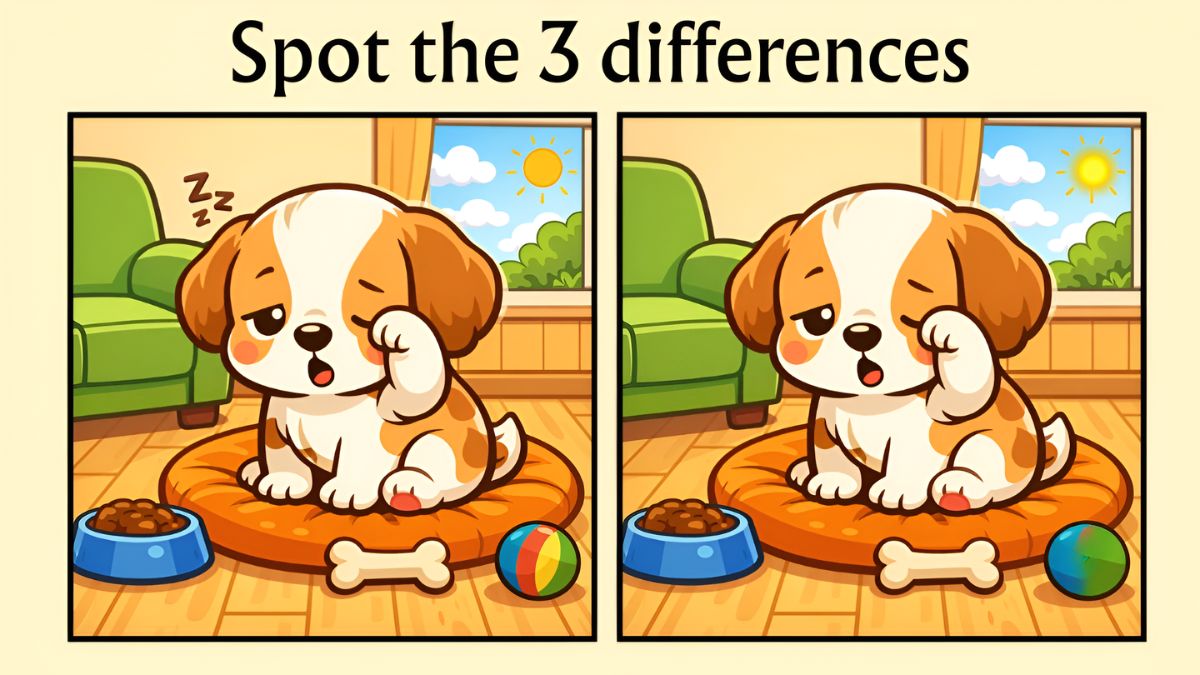
The “Spot the Difference: The Lazy Dog Puzzle That Tricks Your Brain” offers a delightful yet challenging experience for participants. In this engaging test, you’re shown two nearly identical cartoon images featuring a sleepy puppy resting on a bed in a cozy room. The background includes familiar elements such as a green armchair, a bright window, toys scattered on the floor, and a nearby food bowl. Your mission is clear: find exactly three differences in just 10 seconds. However, the puzzle’s design cleverly plays on how human attention operates, making it trickier than it seems.



This specific puzzle merges comfort with challenge. The scene feels inviting and familiar, prompting your brain to categorize it as “the same picture twice.” Consequently, it stops performing careful comparisons, leading to the inevitable trap. To succeed, you must override that instinct and intentionally scan the images for differences.
Why this puzzle feels harder than it looks
Your visual system is designed for speed rather than precision. In real life, you typically don’t need to scrutinize every detail of your surroundings to navigate them; you simply grasp the “gist” of the scene (a dog sleeping, a bright window, toys present). While this efficiency is advantageous, it is precisely why subtle differences can elude you in puzzles like this.


In a set of two similar images, your brain engages in prediction. After recognizing the general layout, it begins to fill in the gaps automatically, assuming continuity between the left and right images. Under time constraints, you tend to perform a broad overview rather than a detailed comparison, causing minuscule changes in color, shape, or count to remain unnoticed unless you focus directly on them.
Add to that the positive emotions generated by the cute imagery. This pleasantness can decrease analytical rigor since you’re enjoying the scene instead of critically analyzing it. This doesn’t suggest you struggle with puzzles; it simply means the art is doing its job effectively.


The brain science behind “change blindness”
This puzzle serves as a practical demonstration of “change blindness,” a notable phenomenon in perception research. Psychologist Ronald Rensink and others found that individuals often overlook even significant changes when their attention isn’t fixed on the area undergoing change. Your gaze may focus on a detail, yet you might still fail to “register” the difference if your attention is elsewhere.
To grasp this concept better, consider feature binding. Visual attributes such as color, shape, and movement are processed along separate neural pathways and then integrated into coherent objects. When two images share extreme similarity, your brain quickly binds these objects together and regards them as stable. The attentional spotlight—linked to parietal networks—acts as a gatekeeper, allowing only a limited portion of the visual field to receive high-resolution processing at any given moment.


Working memory plays a crucial role here, too. To identify differences, you essentially hold one image in your short-term memory while comparing it against the other. With a strict 10-second limit, maintaining a strong memory comparison becomes fragile. If your focus shifts too rapidly, essential details might not be encoded sufficiently for comparison.
A fast method that actually works in 10 seconds
Engaging in random scanning often feels productive, yet it is typically the slowest approach. Instead, consider a structured and methodical strategy, even when looking at charming imagery.
Try this strategy in your next attempt:
- Divide the image into sections: top (window area), middle (dog and bed), bottom (toys, bowl, floor).
- Examine one section at a time, comparing the left image to the right, without jumping around.
- Focus on “fair puzzle targets”: faces, repeated symbols (like “Z” sleep bubbles), bright items, and high-contrast areas at the edges.
- Employ the flicker trick: quickly alternate your attention between the left and right images to make differences stand out as a perceived “blink.”
- Slow your eye movements slightly, as rapid saccades can skip details; controlled scanning helps catch changes.
This method succeeds because it lowers cognitive load. By concentrating on just one section at a time, you can verify differences more easily.
Solution: the 3 differences in the lazy dog pictures
If you run out of time or want to confirm your answers, here are the three identified differences:
- The sun in the window has additional rays in the right image.
- The ball near the bone changes color: it’s multicolored on the left and solid green on the right.
- One “Z” is absent from the sleeping bubbles above the dog’s head in the right image.
Notice how none of these changes alter the overall meaning of the scene. The dog remains asleep, the room continues to look cozy, and the layout still feels identical. That’s why your brain is inclined to view both images as the same.
What your result says (and what it doesn’t)
If you struggled, it doesn’t reflect poor vision or low intelligence. Many individuals naturally process visuals globally, prioritizing relationships and meaning over minor features. In fact, this broader processing style is beneficial in strategic thinking, leadership, creative ideation, and social reasoning—situations where fixating on small details can be counterproductive.
The most important takeaway is that your performance often mirrors your attentional style. With practice, you can cultivate the ability to oscillate between holistic viewing and detailed inspection, which explains why these puzzles seem simpler over time.
Why these puzzles are still popular in 2025
In a landscape dominated by continuous scrolling and notification-induced distractions, quick visual challenges have emerged as a low-effort way to hone focus. They are fast, shareable, and surprisingly informative. Relying on these puzzles teaches a crucial contemporary skill: resisting automatic perception.
To enhance your skills further, don’t just stick to similar puzzles. Incorporate variations—like differing art styles, broader grids, time constraints, or “find the odd one out” challenges—so your brain becomes more versatile rather than merely learning patterns. Consistency proves more impactful than difficulty; dedicating just a few minutes daily can significantly enhance your ability to immediately focus on relevant details.
Frequently Asked Questions
What is the lazy dog puzzle?
The lazy dog puzzle is a visual challenge where you must spot differences between two nearly identical cartoon images featuring a sleeping puppy.
Why are spot-the-difference puzzles effective?
These puzzles are effective because they engage your visual perception skills and challenge your attention, promoting cognitive flexibility and attention to detail.
How can I improve my performance in these puzzles?
You can improve performance by following structured methods, focusing intently on one section at a time, and practicing regularly to enhance your perceptual skills.
Is it normal to struggle with these puzzles?
Yes, many people find these puzzles challenging, as our brains often prioritize overall impressions over detailed comparisons.
What benefits do spot-the-difference puzzles offer?
They enhance visual attention, boost cognitive skills, and provide a entertaining way to stimulate your brain in today’s fast-paced environment.

