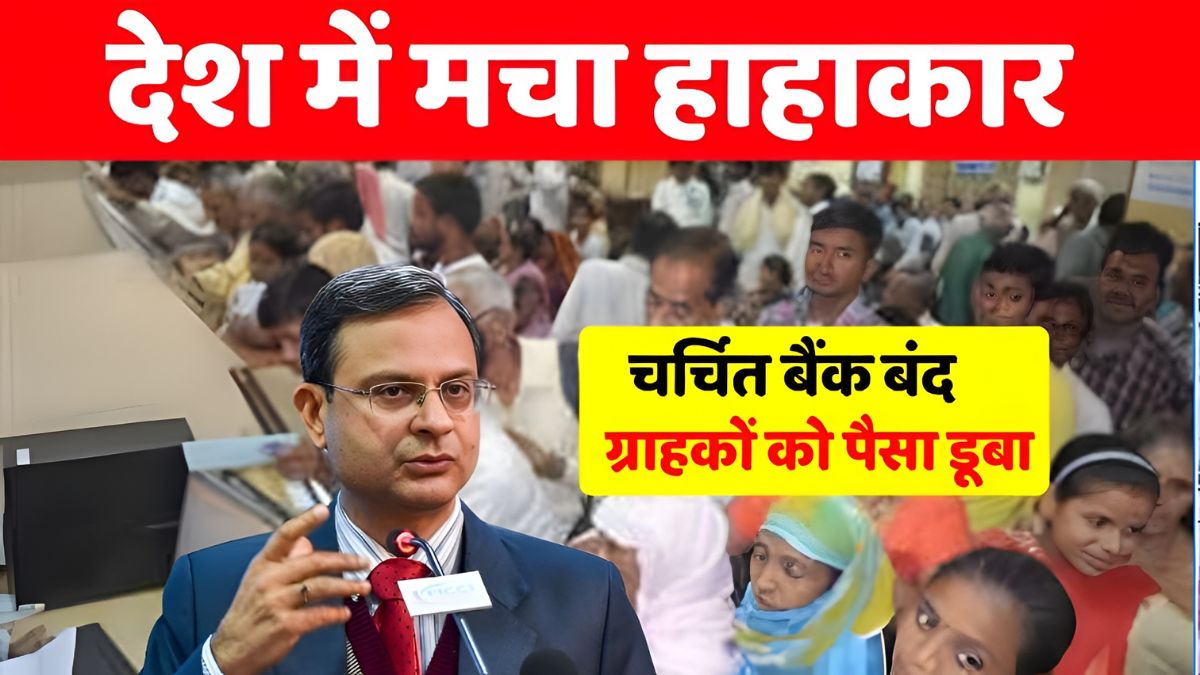
The banking landscape in India is facing a significant upheaval. The Reserve Bank of India (RBI) has ordered the immediate suspension of services for a prominent cooperative bank due to its failing financial health. This unexpected move has left customers anxious, fearing for the safety of their hard-earned money. The RBI’s intervention aims to mitigate financial risks and protect public deposits without delay.



Why Was the Bank Shut Down?
When a bank’s financial stability deteriorates to the point where it can no longer manage customer deposits, the RBI steps in with specific guidelines. This aims to prevent potential resource misuse and safeguard customer interests.
Consequently, major banking services such as withdrawals, transactions, account openings, and loan issuance are either limited or temporarily halted. These precautionary measures help avert further financial damage.


However, this action is not permanent. The RBI keeps a close watch on the situation, allowing banks opportunities for recovery and improvement.
Will Your Deposit Money Sink?
In light of this news, many customers are understandably worried about the safety of their funds. It’s essential to note that in India, every authorized bank is required to provide deposit insurance coverage of up to ₹5 lakh as mandated by the RBI.


This means that even in the event of a bank’s complete failure, customers are entitled to receive back up to ₹5 lakh. This insurance applies to various account types including savings accounts, fixed deposits, and current accounts.
Thus, customers with deposits under ₹5 lakh need not fear total loss. The existing insurance mechanism offers crucial protection for small depositors.


What Should You Do Now?
If your account is with the affected bank, first and foremost, remain calm. In such situations, carefully reviewing the official notifications or information on the bank’s website is crucial.
Additionally, ensure that all pertinent documents like passbooks, account statements, and Aadhaar link records are secure. The RBI and the bank will provide consistent updates, so keep your mobile number and email on file with the bank current.
Moreover, avoid making impulsive decisions fueled by unverified information. Always depend on official communications from the bank or the RBI for accurate updates.
Steps to Take Immediately
- Gather and organize all banking-related documents.
- Check the bank’s official website for any updates.
- Keep your contact details up to date with the bank.
- Avoid panic withdrawals if partial services remain operational.
- Contact the bank’s customer service for any clarification you may need.
Can the Bank Resume Operations in Future?
The RBI’s decision does not have to be permanent. The central bank closely supervises the bank for a designated period to assist in its financial rehabilitation.
If the bank manages to enhance its financial condition during this time, it can restart its services. Additionally, weaker institutions may sometimes be merged with stronger ones, ensuring the safeguarding of customer deposits and continuation of banking operations.
This merger strategy has historically proven effective for many cooperative banks.
Understanding Deposit Insurance Coverage
The Deposit Insurance and Credit Guarantee Corporation (DICGC) provides essential insurance coverage for bank deposits in India. This insurance includes both principal amounts and interest amounts up to ₹5 lakh for each depositor per bank.
The coverage is applicable to a variety of deposit types including savings accounts, fixed deposits, current accounts, and recurring deposits. However, it does not extend to government deposits, inter-bank deposits, or deposits from foreign governments.
In the event of a bank failure, the process to claim insurance typically takes a few months, but the DICGC strives to ensure the swift settlement of claims for impacted depositors.
Conclusion
While RBI’s decision to close bank operations may appear alarming, there are robust protective measures in place for small depositors through insurance coverage. Customers should maintain composure and follow official channels for updates.
The banking sector possesses effective mechanisms to manage such challenges. Thus, customers should focus on keeping their documents organized and staying informed through official communications rather than succumbing to panic.
Disclaimer: This article synthesizes information from various media reports and public guidelines issued by the RBI. Readers are encouraged to confirm details through the concerned bank or the RBI’s official website prior to making any financial decisions.
Frequently Asked Questions
Is my money completely lost if RBI closes a bank?
No, your money up to ₹5 lakh is protected under deposit insurance. The DICGC ensures that small depositors can recover their funds even if a bank fails.
How long does it take to get money back from a closed bank?
The claim process for deposit insurance usually takes several months. The DICGC aims to settle these claims promptly, typically within 90 days after the bank’s closure.
Can RBI reopen a closed bank?
Yes, if the bank improves its financial status during the supervision period, the RBI might permit it to resume operations. Alternatively, it may be integrated with another bank.
What documents do I need to claim deposit insurance?
You will need your passbook, account statements, identification proof, and other relevant banking documents that establish your deposit relationship with the bank.
Does deposit insurance cover all types of bank accounts?
Yes, it covers savings accounts, current accounts, fixed deposits, and recurring deposits, but excludes government deposits and inter-bank deposits.

